- Scope
- Booking structure, bilingual UX, content
- Place
- Maadi, Cairo
- Languages
- Arabic & English
- Engagement
- Published project
- By
- Bigad Elsherif, founder of Appstruct
A house with four rooms and two doors
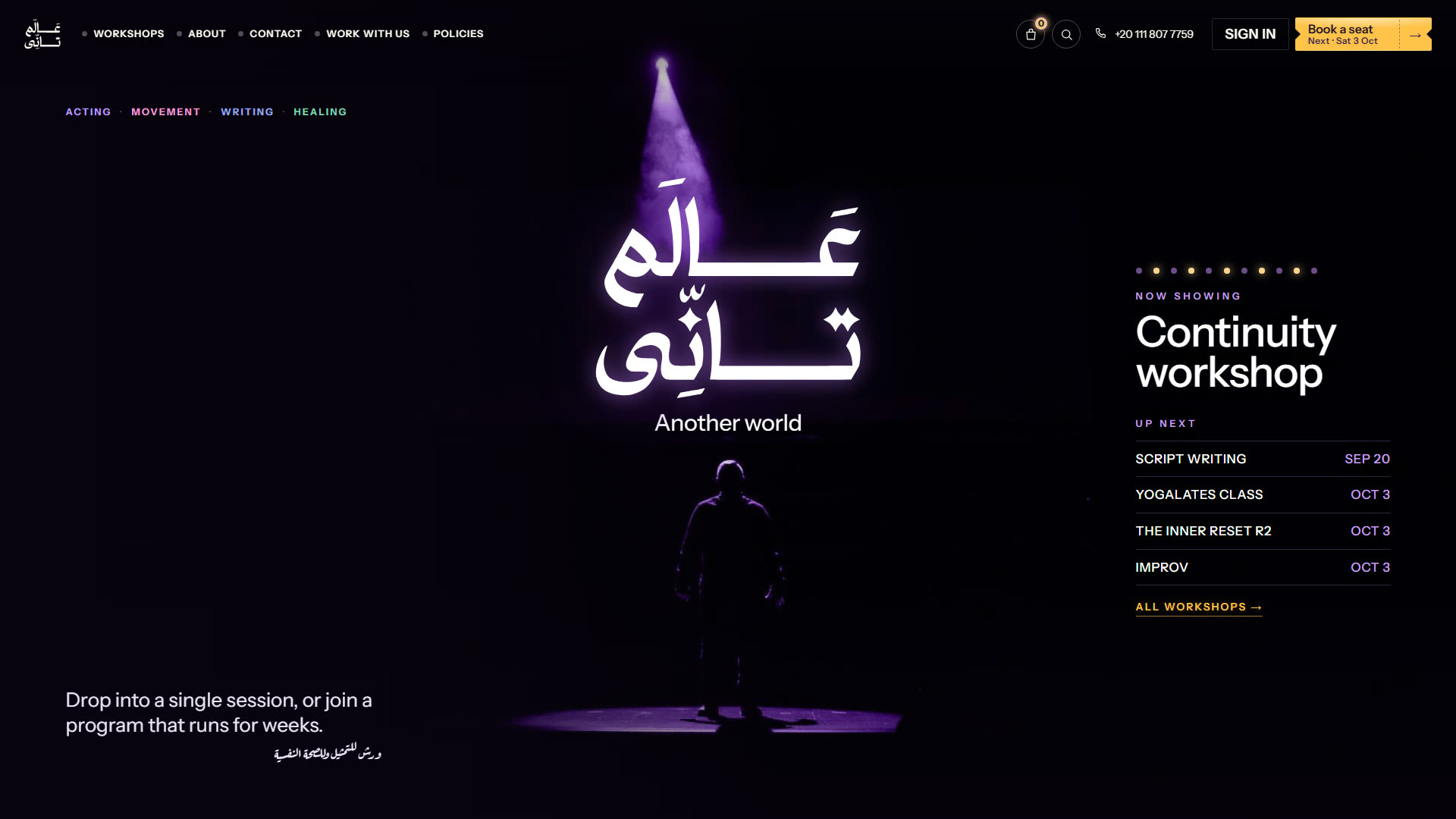
3alam Tany — عالم تاني, “another world” — is a workshop house in Maadi, Cairo. It teaches acting, movement, writing and healing, and it sells two quite different things under one roof: single sessions anyone can book, and programmes that run for weeks and begin with an interview.
That second fact is the whole design problem. A visitor arriving at a workshop listing has one question before any other — can I just turn up, or do I have to apply? Most class booking sites answer it somewhere in the small print of a detail page, which is several clicks after the person has already chosen.
Visit the live siteSee it live
What made it hard
The brief looked like a listings site. It was not.
- —Two products with opposite commitments — a walk-in you book in a minute, and a long-form programme that starts with an interview — presented in the same list.
- —Arabic and English both carry meaning here. The house's name, its invitations and its emotional register are Arabic; much of the practical detail is English. Neither is a translation of the other.
- —Facilitators change by session, so the schedule is the product. A static page of course descriptions would be out of date the week it shipped.
- —A visitor deciding whether to spend an evening on a workshop is making an emotional choice, not a transactional one. The booking surface still has to feel like the room it is selling.
What we did
Three decisions carry most of the work.
Name the two doors, and explain them where people choose
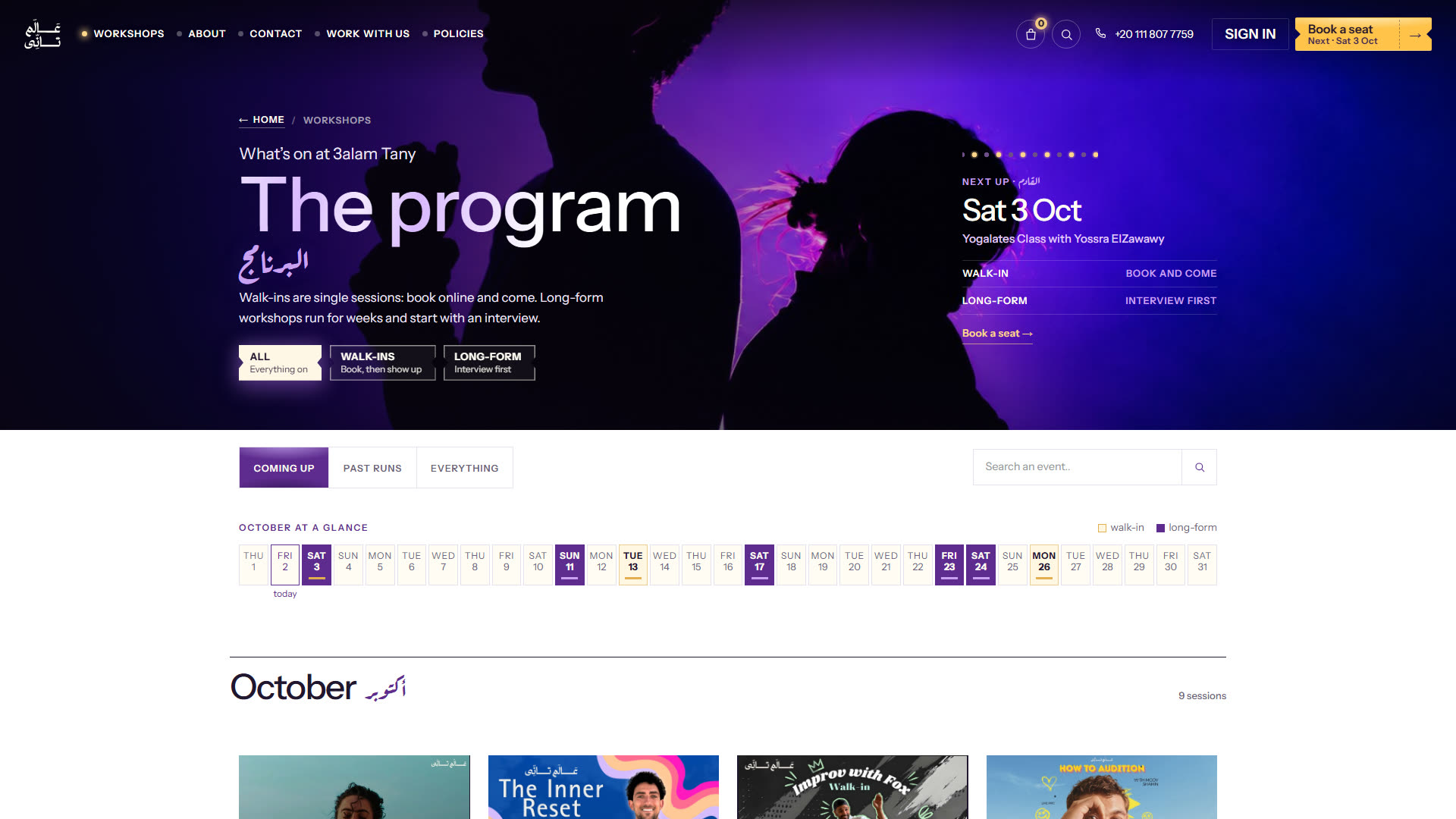
Walk-in and long-form are separated everywhere a choice is made, and each carries its own one-line explanation — “book, then show up” against “interview first”. The distinction appears on the home page, as filters on the programme, and again in the panel showing the next session, so the question is answered before it is asked rather than buried in a detail page.
A programme, not a product catalogue
The language is the house's own: now showing, up next, the programme, past runs. A workshop house that teaches acting is already a venue with a schedule, and borrowing the vocabulary of a theatre listing made the structure obvious without explaining it. It also makes a sold-out past session an asset rather than a dead page.
A month you can read at a glance
Above the session cards sits a strip of the whole month, with each date marked by which door it belongs to. Density and type are legible before any scrolling — a visitor can see that a week is busy, or that the only thing running is long-form, without opening anything.
Arabic as a companion line, not a second site
Arabic sits alongside the English rather than behind a language switch that swaps one for the other: the display face carries the name and the invitations, and the practical lines stay plain and legible in both. The structure is the same in either language, so nothing depends on reading one of them.
Where it stands
The site is live, running a real schedule with named facilitators and taking bookings.
Walk-in and long-form are distinguishable at every point a visitor makes a choice.
The structure holds as the programme turns over, because the schedule is the page rather than something described on it.